

This article will walk you through how to read a TOPSCINET profile page and why some details (like rank, fields, or institute) can change from year to year. If you have not yet claimed your profile, read the step‑by‑step article on how to claim your Top 2% Scientists profile on TOPSCINET at this link: https://top2percentscientists.com/claim-your-top-2-scientists-profile-on-topscinet-2025/,
This article provides a structured overview of how to interpret a TOPSCINET profile page and understand why specific elements, such as rank, field classifications, and institutional affiliations, may vary from year to year. Here we will explain the following:
. Career Data vs Single Year Data
. What do the main metrics mean
. Why your rank can change each year
. Why can the Main Field, Subfields, or Institute names be different
. Why a profile might be missing in some years
. Why someone may appear in one database but not the other
. What to do if something looks wrong
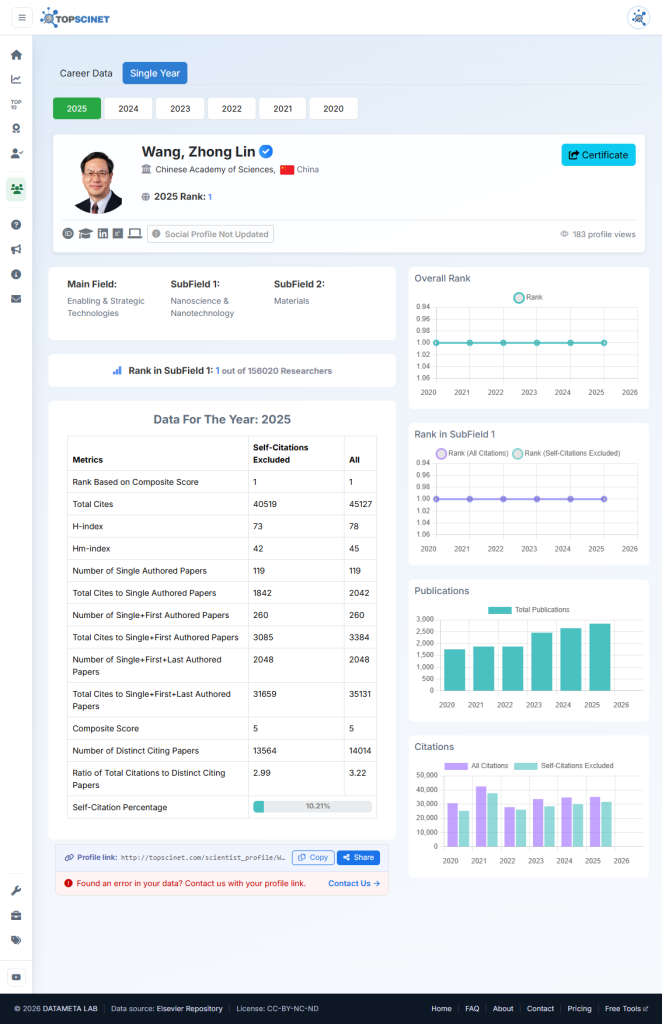
1. Career Data vs Single Year Data
At the top of the profile, you will see two main tabs: Career Data and Single Year. These come directly from the Stanford/Elsevier “World’s Top 2% Scientists” databases, which are also split into two parts.
- Career Data
- Covers your citation impact across your whole career up to the end of the previous year.
- Looks at everything you have published and how often it has been cited over time.
- Useful to understand your long‑term impact in your field.
- Single Year Data
- Focuses on citations received in one specific calendar year only (for example, 2024 or 2025).
- Shows how strong your impact was in that particular year, even if your overall career is still early.
Because these are two separate datasets, a scientist can:
- appear in both (strong overall career and strong recent year),
- appear only in Career Data (long, influential career, but a quieter recent year), or
- appear only in Single Year (rapid recent impact, but total career impact not yet in the top group).
2. What do the main metrics table mean
In the “Data for the Year” or career table, you will see typical Stanford/Elsevier metrics such as Total Citations, h‑index, hm‑index, Composite Score (c‑score), and counts of single‑author / first‑author / last‑author papers.
- Total Citations – how many times your work has been cited in the Scopus database.
- h‑index – you have an h‑index of h if h of your papers have at least h citations each; it mixes productivity and impact.
- hm‑index – an h‑index adjusted for co‑authorship.
- Composite Score (c‑score) – a combined indicator built from several citation metrics and author positions, and it is the main number used to calculate your ranking.
You will often see columns “Self‑Citations Excluded” next to these metrics. The ranking itself is based on versions that limit or remove self‑citations to reduce bias from excessive self‑referencing.
The graphs on the right (overall rank, rank in subfield, publications, citations) simply visualize how these metrics and ranks change over the years.
3. Why your rank can change each year
It is normal for your rank to move up or down from year to year. Reasons include:
- Your own citations change
- New papers get published.
- Older papers continue (or stop) getting cited.
- Other scientists’ performance changes
- If many colleagues in your field receive more citations in a given year, your relative position can fall even if your own numbers did not get worse.
- Updates to the underlying database
- Every new Stanford/Elsevier release updates data and can correct earlier records, which may shift ranks slightly.
So a lower rank in a certain year does not mean your work became weaker; it just reflects the new data and the global competition in that year.
4. Why Main Field, Subfields, or Institute names can be different
On your profile, you will see a Main Field and usually SubField 1 / SubField 2, plus your institution name. These labels may not always look the same for every year, and sometimes they may not match your current affiliation exactly. Common reasons:
- Classification rules can change
- Stanford/Elsevier sometimes refines field and subfield definitions or reclassifies some journals and authors.
- When this happens, your older and newer data might show slightly different field names.
- Name spelling and data cleaning
- Author and institute names in the raw Scopus data can be spelled in different ways or include old affiliations.
- If the algorithm links different spellings to different records, you might temporarily see multiple profiles or missing years.
- Manual edits on TOPSCINET
- Once you claim your profile and subscribe to an editing plan, you can update your institute name, country, Main Field, and SubField 2 directly in TOPSCINET (SubField 1 is locked because it is used for ranking graphs).
- If you edited your information in one year but earlier years still show the old data, this reflects the difference between the original Stanford/Elsevier records and the curated TOPSCINET view for your profile.
If you notice duplicate profiles or inconsistent spellings across years (for example, “Zhang, Wei” vs “Zhang, W.” or different institute names for the same period), you can contact the TOPSCINET team (send an email to [email protected]) and ask them to merge profiles and clean up your record. This helps keep your ranking history accurate and easier to understand.
5. Why a profile might be missing in some years
Sometimes your profile appears for some years but disappears for others. There are a few common explanations:
- Did not meet the cut‑off that year
- The Stanford/Elsevier list only includes scientists whose composite score is high enough to fall into the top group (about the top 2% globally or the top 100,000).
- If your single‑year impact in a particular year is below the cut‑off, you will not appear in that year’s single‑year dataset, even if you appear in career data or in earlier/later years.
- Spelling or ID mismatch
- Minor changes in how your name or affiliation are recorded in Scopus can cause the algorithm to treat some records as a different person.
- In that case, your citations for that year might be attached to a separate profile, so the year looks “missing” on your main profile.
- Data updates and corrections
- Occasionally, records are added, corrected, or merged in later releases, which can cause older years to appear or disappear compared with earlier versions of the list.
If you suspect that a missing year is due to spelling or record‑linking issues, you can:
- Search TOPSCINET for similar versions of your name to see if another profile holds that year’s data.
- Contact the TOPSCINET support team (using the “Contact Us” or send an email to [email protected]) and ask them to merge the profiles into a single, consistent record.
6. Why someone may appear in one database but not the other
Because career‑long and single‑year rankings are built separately, it is completely normal to see different sets of names in each list.
- A researcher with a long history of highly cited work but fewer recent citations might be strong in Career Data only.
- A younger or fast‑rising researcher with a high‑impact recent paper might show up in Single Year only, because their overall career citations are still below the career cut‑off.
- Only scientists who meet the threshold in both datasets appear in both views.
When you look at a TOPSCINET profile, check both tabs to understand whether the scientist’s strength is mainly long‑term impact, recent momentum, or both.
7. What to do if something looks wrong
If you see:
- incorrect institute or country,
- wrong or outdated field labels,
- duplicate profiles under slightly different spellings, or
- missing years that you believe should be there,
you should:
- Claim your profile on TOPSCINET if you have not already done so, so the team can verify your identity.
- Use the “Contact Us” or “Found an error in your data?” link on your profile to send details (including the year, spelling, or duplicate profile URLs).
- Ask the team specifically to merge profiles or correct institute / field labels where needed.
- Send an email to [email protected]
This keeps the global database clean and ensures that your career is represented as accurately as possible.
Searchable Database for Top 2% Scientists
Visit TOPSCINET.com
If your name appears in the search results, claim your profile using your institutional email to update your social media links and enhance your online presence.



Dear Support Team,
My profile appears twice on your platform under the following names:
– Ahmed Jamal Abdullah Al-Gburi
– A. J.A. Al-Gburi
Both profiles belong to me, as shown in the attached screenshots. Could you please merge them into one account under my full name, Ahmed Jamal Abdullah Al-Gburi, while retaining all associated records and recognition details?
I would like to renew my membership and complete my registration using the merged account. Please let me know if you require any additional information.
Thank you for your assistance.
Best regards,
Assoc. Prof. Ahmed Jamal Abdullah Al-Gburi
Asia Pacific University of Technology & Innovation (APU), Malaysia
We have updated your profile: https://topscinet.com/scientist_profile/Al-Gburi,%20Ahmed%20Jamal%20Abdullah/2017/?stype=single_year