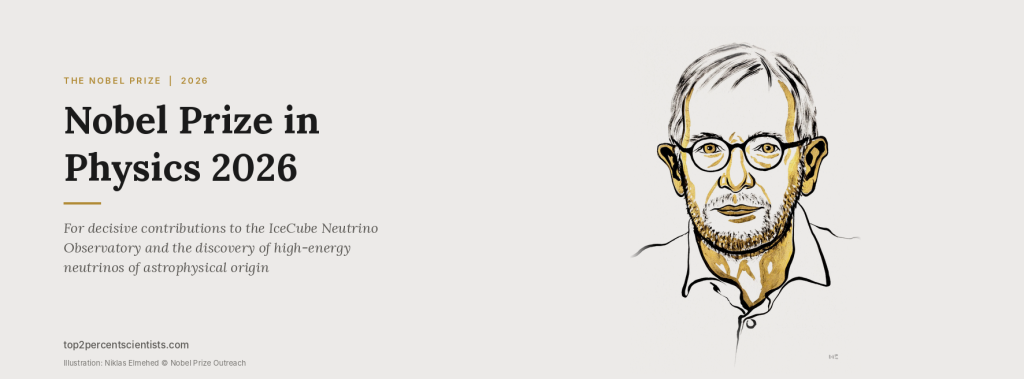

The Royal Swedish Academy of Sciences has awarded the Nobel Prize in Physics 2026 to Francis Halzen of the University of Wisconsin–Madison, USA, “for decisive contributions to the IceCube Neutrino Observatory and the discovery of high-energy neutrinos of astrophysical origin.” The prize was announced on October 6, 2026.
What Are Neutrinos?
Neutrinos are everywhere, but they almost never interact with anything. Trillions pass through the Earth and through our bodies without being noticed. Very rarely, a single neutrino hits an atomic nucleus, and that collision is what makes detecting one possible.
The universe contains natural particle accelerators that give particles up to a million times more energy than any laboratory on Earth can. Most particles from these sources are bent by magnetic fields or blocked by dust on their way to us. Neutrinos are not. They travel in a straight line and keep their energy, so they point straight back to where they came from.
The Idea: A Telescope Made of Ice
Francis Halzen first presented his vision for catching neutrinos at the South Pole in 1988. When a neutrino collides with an atomic nucleus in the ice, it gives off a faint flash of light. Light sensors frozen deep in the clear glacial ice can record that flash.
The South Pole was the right place for several reasons:
- The ice is extremely clear and free from many types of interference.
- The area is geologically stable, with no earthquakes.
- The ice offers an enormous volume, which matters because high-energy cosmic neutrinos are very rare.
The IceCube Neutrino Observatory
IceCube is a full cubic kilometre of ice fitted with light sensors on long cables, set roughly 1,450 to 2,450 metres below the surface. A building on the surface collects the signals and transmits the data via satellite for analysis. The observatory was completed in 2011.
Researchers soon detected the first high-energy neutrinos. A few years later, they published proof that some of these neutrinos must come from far outside our solar system. That discovery started a new kind of astronomy: studying the universe through neutrinos instead of light alone.
[Insert illustration: An observatory in the ice]
Caption: © Johan Jarnestad/The Royal Swedish Academy of Sciences
Francis Halzen
Francis Halzen was born in 1944 in Tienen, Belgium, and earned his PhD at the University of Louvain. He has been on the faculty of the University of Wisconsin–Madison since 1972 and is Hilldale and Gregory Breit Distinguished Professor of Physics. He is the principal investigator of IceCube and led its predecessor experiment, AMANDA.
“Francis Halzen has led an international team of researchers and engineers who have provided us with a fantastic instrument. His tenacity and scientific vision has paved the way for a new kind of astronomy,” said Mark Pearce, Chair of the Nobel Committee for Physics.
Research profile: Francis Halzen on TOPSCINET
Why This Prize Matters
IceCube keeps collecting neutrino events every day. These events will tell researchers more about the violent places in the universe where high-energy neutrinos are made, and they could reveal cosmic phenomena that no one has seen yet.
Frequently Asked Questions
Who won the Nobel Prize in Physics 2026?
Francis Halzen of the University of Wisconsin–Madison, USA.
Why did Francis Halzen win the Nobel Prize?
For decisive contributions to the IceCube Neutrino Observatory and the discovery of high-energy neutrinos of astrophysical origin.
What is IceCube?
A neutrino observatory at the South Pole made of a cubic kilometre of ice fitted with light sensors. It detects the light flashes produced when neutrinos collide with atoms in the ice.
How much is the Nobel Prize in Physics 2026 worth?
The prize is 12 million Swedish kronor, about US$1.21 million. The Nobel Foundation raised it from 11 million kronor for 2026.
Does Francis Halzen share the prize money?
No. He is the sole laureate this year, so he receives the full 12 million kronor. When a prize goes to more than one person, the amount is divided between them.
How much does Francis Halzen receive in US dollars?
About US$1.21 million, depending on the exchange rate. He will also receive a Nobel medal and a diploma at the ceremony in Stockholm on December 10.