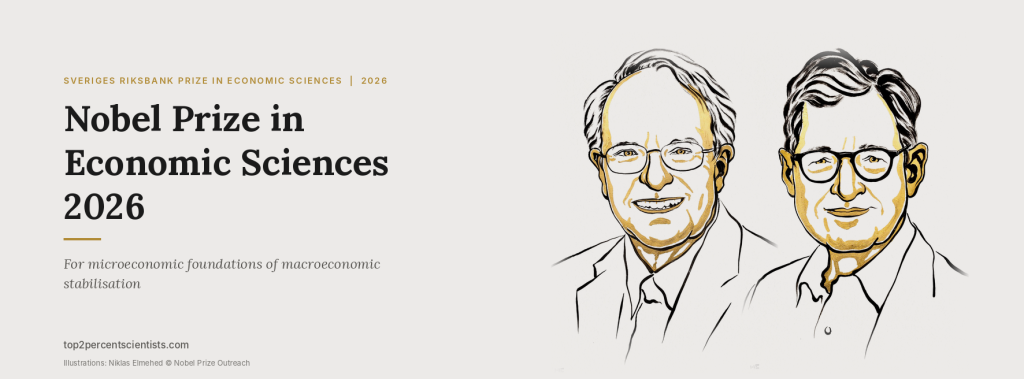

The Royal Swedish Academy of Sciences has awarded the Sveriges Riksbank Prize in Economic Sciences in Memory of Alfred Nobel 2026 to Robert E. Hall of Stanford University and Michael Woodford of Columbia University, USA, “for microeconomic foundations of macroeconomic stabilisation.” The prize was announced on October 12, 2026.
What Is Stabilisation Policy?
Economies move through booms and recessions. Since John Maynard Keynes developed his theories almost a century ago, governments and central banks have tried to smooth out these swings. In a recession, they lower interest rates and increase the budget deficit to boost the economy. In a boom, they do the opposite to cool it down.
When the Old Models Failed
During the oil crises of the 1970s, the Keynesian models that guided these decisions stopped working. Policy did not reduce unemployment and led to uncontrolled inflation instead. The West went through a decade of low growth, high unemployment and high inflation, and many economists argued that stabilisation policy did more harm than good.
The Laureates’ Contribution
Hall and Woodford showed how to rebuild the models so stabilisation policy could work again. The old models relied on statistical links between big economic numbers such as inflation, production and consumption. The new models are built on a microeconomic foundation: how millions of individual households and businesses make decisions, and how those decisions add up to the economy as a whole.
A key idea is that households and businesses are forward looking. They think about the future when they decide how much to save or what prices to set. When governments and central banks clearly communicate their plans, they can shape those expectations and move the economy in the right direction.
Robert E. Hall
Robert E. Hall was born in 1943 in Palo Alto, California. He earned his PhD in 1967 at the Massachusetts Institute of Technology and is a professor at Stanford University. His work showed that, because households look ahead, changes in their consumption cannot be predicted from past data, a finding that helped put forward-looking behavior at the center of macroeconomics.
Research profile: Robert E. Hall on TOPSCINET
Michael Woodford
Michael Woodford was born in 1955 in Chicopee, Massachusetts. He earned his PhD in 1983 at the Massachusetts Institute of Technology and is a professor at Columbia University. His work laid the theoretical foundation for modern monetary policy, showing how central banks can steer the economy by managing expectations about future interest rates.
Research profile: Michael Woodford on TOPSCINET
Why This Prize Matters
“The laureates’ work has provided us with a stable theoretical foundation for the models that are now used by central banks and governments around the world. With them, we are better equipped to deal with shocks in the economy, such as energy crises or sudden changes in how much households consume,” said John Hassler, Chair of the Committee for the Prize in Economic Sciences.
Frequently Asked Questions
Who won the Nobel Prize in Economics 2026?
Robert E. Hall of Stanford University and Michael Woodford of Columbia University, both in the USA.
Why did they win?
For microeconomic foundations of macroeconomic stabilisation. They built the models that central banks and governments use to smooth out booms and recessions.
Is the economics prize a real Nobel Prize?
Its official name is the Sveriges Riksbank Prize in Economic Sciences in Memory of Alfred Nobel. Sweden’s central bank founded it in 1968. It is awarded by the Royal Swedish Academy of Sciences under the same rules as the original Nobel Prizes and is widely called the Nobel Prize in Economics.
How much is the Nobel Prize in Economics 2026 worth?
The prize is 12 million Swedish kronor, about US$1.21 million.
Do Hall and Woodford share the prize money?
Yes. The prize is shared equally between the two laureates.
How much does each laureate receive in US dollars?
Each receives 6 million Swedish kronor, about US$605,000, depending on the exchange rate. Each will also receive a medal and a diploma at the ceremony in Stockholm on December 10.