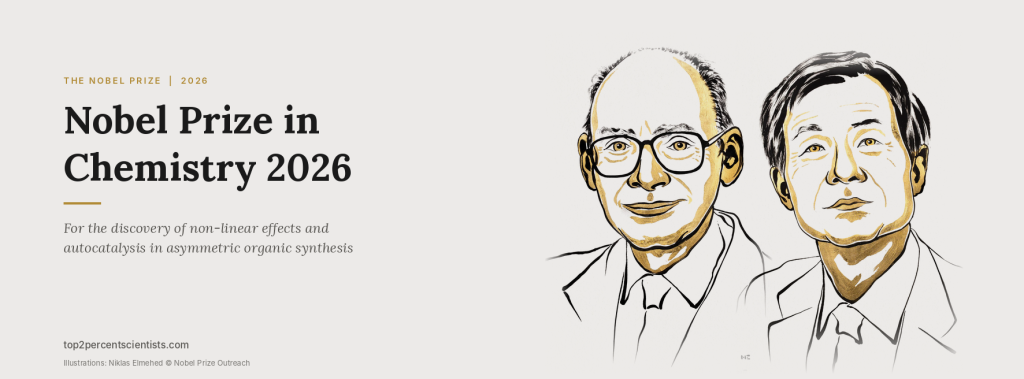

The Royal Swedish Academy of Sciences has awarded the Nobel Prize in Chemistry 2026 to Henri B. Kagan of Université Paris-Sud, France, and Kenso Soai of Tokyo University of Science, Japan, “for the discovery of non-linear effects and autocatalysis in asymmetric organic synthesis.” The prize was announced on October 7, 2026.
What Is Chirality?
Many molecules, including amino acids, exist in two forms that are mirror images of each other, like a left and a right hand. Chemists call these molecules chiral, and the two forms are called enantiomers.
Life uses only one of the two forms. The proteins in your cells are built from one mirror image of each amino acid, and the other form is rarely found in nature. Chemists call this homochirality, from the Greek words for “same” and “hand.”
A Century-Old Mystery
When chemists ran reactions that could form either mirror image, they always got equal amounts of both. That made it hard to explain how life ended up with only one. It also mattered in practice: in medicines and other molecules that act on the body, often only one mirror image has the desired effect.
Kagan’s Discovery: Non-Linear Effects (1986)
To favor one mirror image, chemists use a chiral catalyst, often a metal ion combined with one form of a chiral molecule. The catalyst partly passes its “handedness” on to the product.
In 1986, Henri Kagan asked what would happen if the catalyst contained a mix of left and right forms. He found that the result was not a simple average. Mixed left-right catalysts barely worked, so the form in excess took over and the reaction produced a much larger excess of one mirror image than anyone had thought possible. This is called a non-linear effect.
Soai’s Breakthrough: Autocatalysis (1995 to 2003)
Kenso Soai took the next step. In a key 1995 publication, he described a reaction whose product is itself a chiral catalyst that speeds up its own formation. This is called autocatalysis.
In 2003, he succeeded in making the reaction form only one of the two mirror images. Starting from a tiny excess of one form, the reaction amplified it with each run until that form made up more than 99.5 percent of the product. Other than life itself, no one had achieved this before.
Henri B. Kagan
Henri B. Kagan was born in 1930 in Boulogne-Billancourt, France. He earned his doctorate at the Collège de France and is emeritus professor at Université Paris-Sud in Orsay. Beyond non-linear effects, he is known for the DIOP ligand used in asymmetric catalysis and for samarium iodide, a reducing agent often called “Kagan’s reagent.”
Research profile: Henri B. Kagan on TOPSCINET
Kenso Soai
Kenso Soai was born in 1950 in Japan. He earned his PhD at the University of Tokyo in 1979 and has spent his career at Tokyo University of Science, where he became a full professor in 1991. The reaction he designed is known as the Soai reaction.
Research profile: Kenso Soai on TOPSCINET
Why This Prize Matters
“Henri Kagan and Kenso Soai have provided a solution to a chemical mystery that is over a century old: how homochirality can emerge spontaneously. The chemical reactions they have developed are spectacular,” said Heiner Linke, chair of the Nobel Committee for Chemistry.
Their discoveries show how homochirality can arise, and they have been decisive for chemists who design reactions to make pharmaceuticals.
Frequently Asked Questions
Who won the Nobel Prize in Chemistry 2026?
Henri B. Kagan of Université Paris-Sud, France, and Kenso Soai of Tokyo University of Science, Japan.
Why did they win?
For the discovery of non-linear effects and autocatalysis in asymmetric organic synthesis. Together, their work explains how chemical reactions can end up producing only one mirror image of a molecule.
What is homochirality?
Homochirality means a group of molecules consists of only one mirror-image form. The amino acids in living organisms are homochiral.
How much is the Nobel Prize in Chemistry 2026 worth?
The prize is 12 million Swedish kronor, about US$1.21 million. The Nobel Foundation raised it from 11 million kronor for 2026.
Do Kagan and Soai share the prize money?
Yes. The prize is awarded jointly, so the two laureates share the 12 million kronor equally.
How much does each laureate receive in US dollars?
Each receives 6 million Swedish kronor, about US$605,000, depending on the exchange rate. Each will also receive a Nobel medal and a diploma at the ceremony in Stockholm on December 10.