
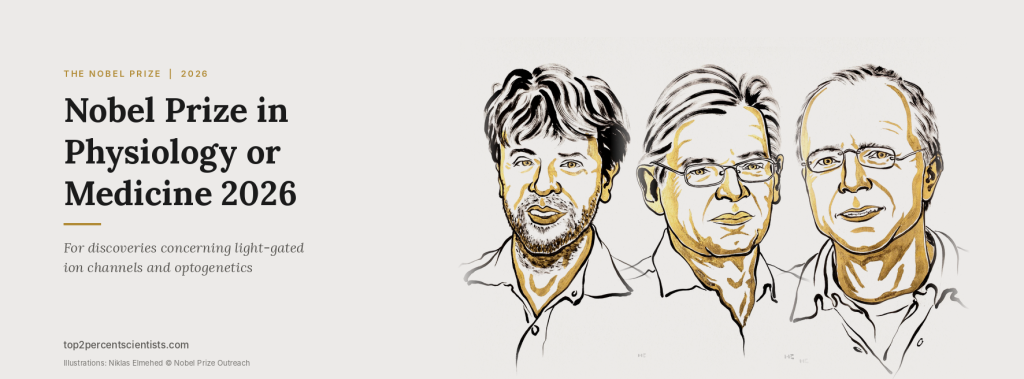

The Nobel Prize in Physiology or Medicine 2026 has been awarded jointly to Karl Deisseroth, Peter Hegemann and Georg Nagel “for their discoveries concerning light-gated ion channels and optogenetics.” The Nobel Assembly at Karolinska Institutet announced the prize on October 5, 2026. The laureates share the 12 million Swedish kronor prize equally.
What Is Optogenetics?
Optogenetics uses light and genetics to control cells. It allows scientists to switch individual nerve cells in a living brain on or off, and it is now used in laboratories around the world to study how the brain produces memory, emotion and behavior.
The Discovery: From Algae to the Brain
The work began with a single-celled green alga, Chlamydomonas, which senses light through a small eyespot. Hegemann and Nagel discovered channelrhodopsin, a protein that made any cell it was placed in sensitive to light. They showed it acts as a light-gated ion channel: when light hits it, the channel opens and positive ions flow into the cell.
Deisseroth then asked Nagel for the DNA encoding channelrhodopsin-2. He introduced the gene into rat nerve cells and showed that a pulse of blue light could trigger a nerve signal, turning the algae protein into a precise switch for neurons.
Karl Deisseroth
Karl Deisseroth, 54, is a professor of bioengineering and of psychiatry and behavioral sciences at Stanford University. He earned his MD and PhD at Stanford. He received the Nobel call late at night, just as he was falling asleep.
Research profile: Karl Deisseroth on TOPSCINET
Peter Hegemann
Peter Hegemann, 71, is Hertie Senior Professor of Neuroscience at Humboldt University of Berlin. His studies of the algal eyespot laid the foundation for the discovery of channelrhodopsin.
Research profile: Peter Hegemann on TOPSCINET
Georg Nagel
Georg Nagel, 73, is Professor of Molecular Plant Physiology at the University of Würzburg. He earned his PhD in biophysics at the University of Frankfurt and carried out the key channelrhodopsin work while at the Max Planck Institute of Biophysics. He heard the news while sitting on a sunny terrace in Italy.
Research profile: Georg Nagel on TOPSCINET
Why This Work Matters
Before optogenetics, researchers could mostly observe brain activity. Now they can control specific cells and test what each one does. The Nobel Committee said the method opens up ways of mapping the brain that scientists once could only imagine.
Frequently Asked Questions
Who won the Nobel Prize in Physiology or Medicine 2026?
Karl Deisseroth, Peter Hegemann and Georg Nagel.
Why did they win?
For their discoveries concerning light-gated ion channels and optogenetics.
What is channelrhodopsin?
A light-sensitive protein from green algae that opens an ion channel when exposed to light, making cells controllable with light.
Where do the laureates work?
Deisseroth at Stanford University (USA), Hegemann at Humboldt University of Berlin (Germany) and Nagel at the University of Würzburg (Germany).
Add these to the FAQ section (and the FAQ schema block):
How much is the Nobel Prize in Physiology or Medicine 2026 worth?
The prize is 12 million Swedish kronor, about US$1.21 million. The Nobel Foundation raised it from 11 million kronor for 2026, the 125th anniversary of the prizes.
Do the three laureates share the prize money, or does each one get the full amount?
They share it. When a Nobel Prize goes to more than one person, the single prize amount is divided between them. Karl Deisseroth, Peter Hegemann and Georg Nagel will split the 12 million kronor equally.
How much does each 2026 medicine laureate receive in US dollars?
Each laureate receives 4 million Swedish kronor, about US$400,000. The exact dollar figure moves with the exchange rate. Each laureate also receives a Nobel medal and a diploma at the award ceremony in Stockholm on December 10.