
Last updated: September 22, 2026
Status: The 2026 update of the Stanford/Elsevier Top 2% Scientists list has not yet been published on the Elsevier Data Repository. This page will be updated as soon as it is.
The 2024 and 2025 editions were both published in mid-September, so many researchers expected the 2026 list around the same time. If you’ve been checking and it isn’t there yet, here’s what that does and doesn’t mean.
Note: top2percentscientists.com is an independent website and is not affiliated with Stanford University or Elsevier. We have no role in producing the list or setting its release date.
Is the 2026 List Delayed?
Not officially. The list has no announced or fixed release date. It is an academic research dataset produced by Prof. John P.A. Ioannidis of Stanford University and collaborators using Scopus data, and it is published when the work is complete.
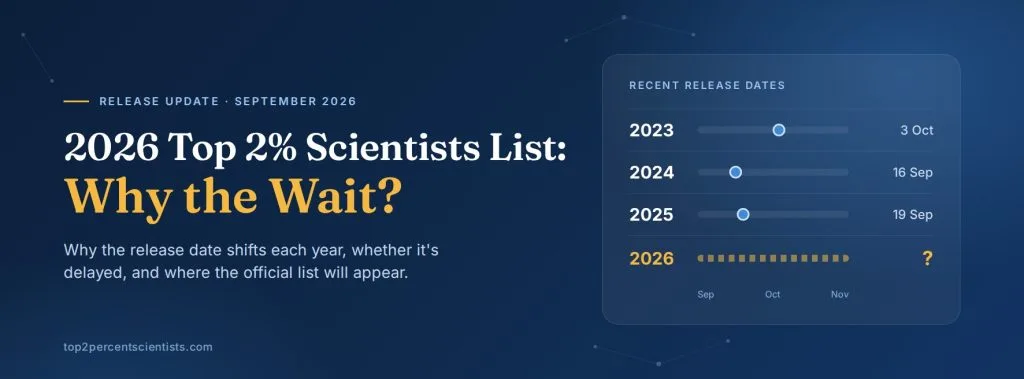
“Mid-September” is a pattern from the last two years, not a schedule. Across all editions, releases have ranged from mid-September to late October:
- 2020–2023: October (7 Oct 2020, 18 Oct 2021, 9 Oct 2022, 3 Oct 2023)
- 2024–2025: mid-September (16 Sep 2024, 19 Sep 2025)
A release in late September or October 2026 would be entirely in line with the list’s history. For the full release timeline, see our earlier post: When Will the Stanford/Elsevier Top 2% Scientist List 2026 Be Released?
Why Hasn’t It Been Released Yet?
No official reason has been published. The factors below are documented features of how the list is built, and each one can shift the release date from year to year.
It is based on a specific Scopus snapshot.
Each edition is calculated from a snapshot of all Scopus author profiles. The 2024 and 2025 editions used August 1 snapshots, the 2023 edition used an October 1 snapshot, and the 2022 edition used a September 1 snapshot. The release date moves with the snapshot and the processing that follows it.
The processing is large-scale.
The database computes citation indicators for all Scopus author profiles, including the h-index, the co-authorship-adjusted hm-index, and the composite c-score, with and without self-citations. It then assigns percentiles across 22 fields and 174 subfields.
New additions need validation.
The dataset evolves over time. The 2024 edition, for example, added data on retracted papers drawn from the Retraction Watch database. Any new feature or method change has to be checked before publication.
Accuracy comes before speed.
The published versions are archival and are not changed after release. The authors say this explicitly on the dataset page. In 2022, a corrected Version 5 was issued about a month after Version 4 to improve subfield assignments. Because a released version is final, taking extra time to get it right matters.
Has the List Been Discontinued?
There is no indication of that. The list has been updated every year since 2019, and nothing on the official dataset page suggests the series has ended. A few extra weeks of waiting is consistent with past years, not a sign of cancellation.
Where Will the 2026 List Appear?
It will be published as a new version of the same dataset on the Elsevier Data Repository (DOI: 10.17632/btchxktzyw). The 2025 edition was Version 8, so the 2026 edition is expected to be Version 9.
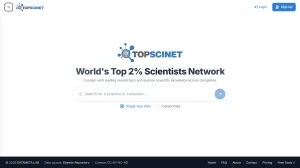
It will be updated on TOPSCINET. They upload both career and single-year lists, where researchers can manage their profiles and see all previous years under one profile.
Be cautious about files or “2026 lists” circulating elsewhere before the official dataset appears. If it isn’t on the Elsevier Data Repository, it isn’t the official release.
What Can You Do While You Wait?

Understand the selection criteria. Scientists are included if they are in the top 100,000 by c-score or rank at the 2nd percentile or above in their subfield. Read our guide to the methodology and selection criteria.
Look up past editions. All earlier lists are searchable on TOPSCINET.
How Will I Know When It’s Released?
We’ll update this page and make the 2026 data searchable on TOPSCINET as soon as the official dataset is published.
- Monitor the Official Datasets: Check the Elsevier Digital Commons Data for official postings.
- Search the Top 2% List: Use our platform TopSCINET.com to confirm your inclusion as soon as the rankings are out
- Follow us on Social Media:
- Instagram: @topscinet
- LinkedIn: Top2PercentScientists
- Facebook: @topscinet
- Twitter (X): @topscinet
- YouTube: Top 2 Percent Scientists
If you have any questions or need assistance, contact us at [email protected]. We’re here to help you stay connected and make the most of your scientific achievements!
Searchable Database for Top 2% Scientists
Visit TOPSCINET.com
If your name appears in the search results, claim your profile using your institutional email to update your social media links and enhance your online presence.