
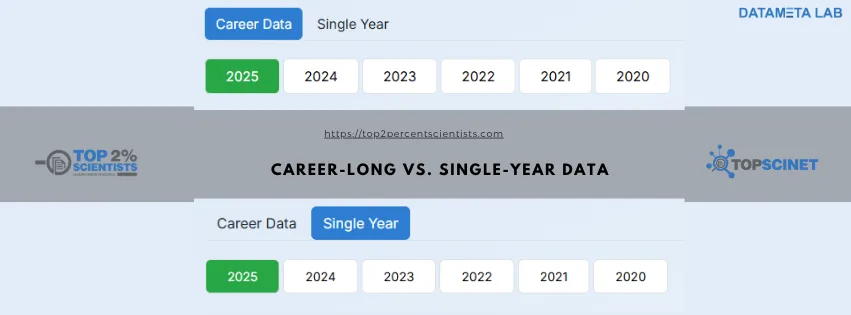

If you have looked at the global ranking of the world’s top 2% scientists, you may have noticed that the data is published in two entirely separate tables. Many researchers wonder why their ranking, citation counts, and h-index vary dramatically between Career-Long and Single Year lists and what the difference is between these two.
The list, compiled by researchers at Stanford University using Scopus data, evaluates scientific impact through two distinct lenses: Career-Long Impact and Single Recent Year Impact. Understanding how these two datasets operate helps clarify the math behind the rankings.
1. Career-Long Impact:
The Career-Long dataset measures a scientist’s cumulative scientific footprint from the day they published their very first paper up until the most recent annual cutoff date.
- What it tracks: Every citation and paper an author has accumulated throughout their entire professional life.
- Who it includes: This list naturally features senior, late-career, retired, and even deceased scientists whose lifetime citation impact continues to remain highly influential globally.
- The structural limitation: Because it rewards long-term accumulation, whole-career metrics place young or early-career scientists at a structural disadvantage, as they have had fewer years to accumulate citations.
2. Single Recent Year Impact:
The Single Recent Year dataset removes the timeline bias by focusing entirely on a scientist’s current research momentum.
- What it tracks: It measures performance strictly by counting citations received during a single calendar year. For example, in the late-2025 iteration of the list, the single-year data strictly counts citations that accrued between January 1, 2024, and December 31, 2024.
- Why it matters: It doesn’t matter if a paper was written in 1995 or 2023; if it was cited in 2024, that citation counts toward the 2024 single-year list. This levels the playing field, allowing productive younger researchers with high current impact to rank alongside established veterans.
Why Metrics Differ From Your Live Scopus Profile
Many scientists point out that the h-index or citation count displayed on their live Scopus profile is much higher than what appears on either Stanford list. This happens for three clear mathematical reasons:
Strict Document Filtering
A standard Scopus profile counts all document types toward an author’s h-index. However, the Stanford algorithm filters the database to focus primarily on peer-reviewed journal articles. It systematically discards secondary document types like editorials, short surveys, errata, letters, and meeting notes before running its calculations.
The Self-Citation Deduction
To ensure fair ranking, the official database calculates its composite metric (c-score) both with and without self-citations. In many instances, a scientist’s h-index will appear lower on the list because the ranking heavily relies on metrics where all citations from the author (or their co-authors) are completely stripped away.
The Annual Data Freeze
Live Scopus updates daily. The Top 2% list relies on a frozen database snapshot taken on August 1st (date may vary each year) of the release year. Any new citations or merged profiles occurring after that date will not appear until the next annual version is published.
References
- [1] Ioannidis, J. P. A., Baas, J., Klavans, R., & Boyack, K. W. (2019). A standardized citation metrics author database annotated for scientific field. PLOS Biology, 17(8), e3000384. https://doi.org/10.1371/journal.pbio.3000384
- [2] Ioannidis, J. P. A., Boyack, K. W., & Baas, J. (2020). Updated science-wide author databases of standardized citation indicators. PLOS Biology, 18(10), e3000918. https://doi.org/10.1371/journal.pbio.3000918
- [3] Ioannidis, J. P. A. (2025). August 2025 data-update for “Updated science-wide author databases of standardized citation indicators”. Elsevier Data Repository, V8. doi.org
Searchable Database for Top 2% Scientists
Visit TOPSCINET.com
If your name appears in the search results, claim your profile using your institutional email to update your social media links and enhance your online presence.


Why “No career-long data for …”
It is an automatic selection process. The selection process is based on specific criteria and methodologies (not only citations). For a comprehensive understanding of the methodology and selection criteria, please refer to this article:https://top2percentscientists.com/methodology-and-selection-criteria-of-top-2-scientists-list/